
Karoliina Koskinen
Sept. 2025
Prior to my employment at the University of Helsinki, I worked as a project researcher at the Centre of Excellence in Game Culture Studies at the University of Turku. During that time, I came across a historical board game called the Game of Helsinki (orig. Helsingin peli-Helsingfors-spelet). The first version of the game was published in 1870, when Finland had just begun industrialising, driven by the growth of the sawmill industry and the expansion of the railway network. As most of the population still lived in the countryside, the game offered an exciting opportunity to transport oneself to an imaginary visual journey across the Finnish capital. With a roll of the dice, the players could visit places such as Kaisaniemi Botanical Garden, Korkeasaari Zoo, and National Theatre, cycle in the city centre, enjoy walks in the Esplanade Park and Kaivopuisto, and in the game’s 1904 version, take a ride on a newly created tram network. To pass the game, the players would have to be careful not to spend all their travel budget on the transport and attractions.

Details from the Game of Helsinki. National Library of Finland.
Jumping back to the year 2025, the game draws a fascinating parallel to the serious game we designed as part of the Transformative Cities project. Also situated in the city of Helsinki, the players can invest in measures such as expanding tram networks, improving the cycle lanes and increasing the coverage of protected urban green areas. Nowadays, as cities face the task of balancing their climate goals with providing housing and functional mobility systems for citizens as well as addressing urban biodiversity decline, the novel serious game methodology simulates urban planning decision-making in a realistic legal and policy context that helps different sectors work together and find solutions to these complex trade-offs.
The idea of the serious game is straightforward: instead of being in the role of a visitor, the participants of the game play as decision-makers with a power to decide how the money is spent towards Helsinki’s growth, climate, and biodiversity goals from the current day until year 2040. The players work with budgets of €3 billion for climate and biodiversity and €4 billion for growth, and must make decisions together using a shared digital platform.
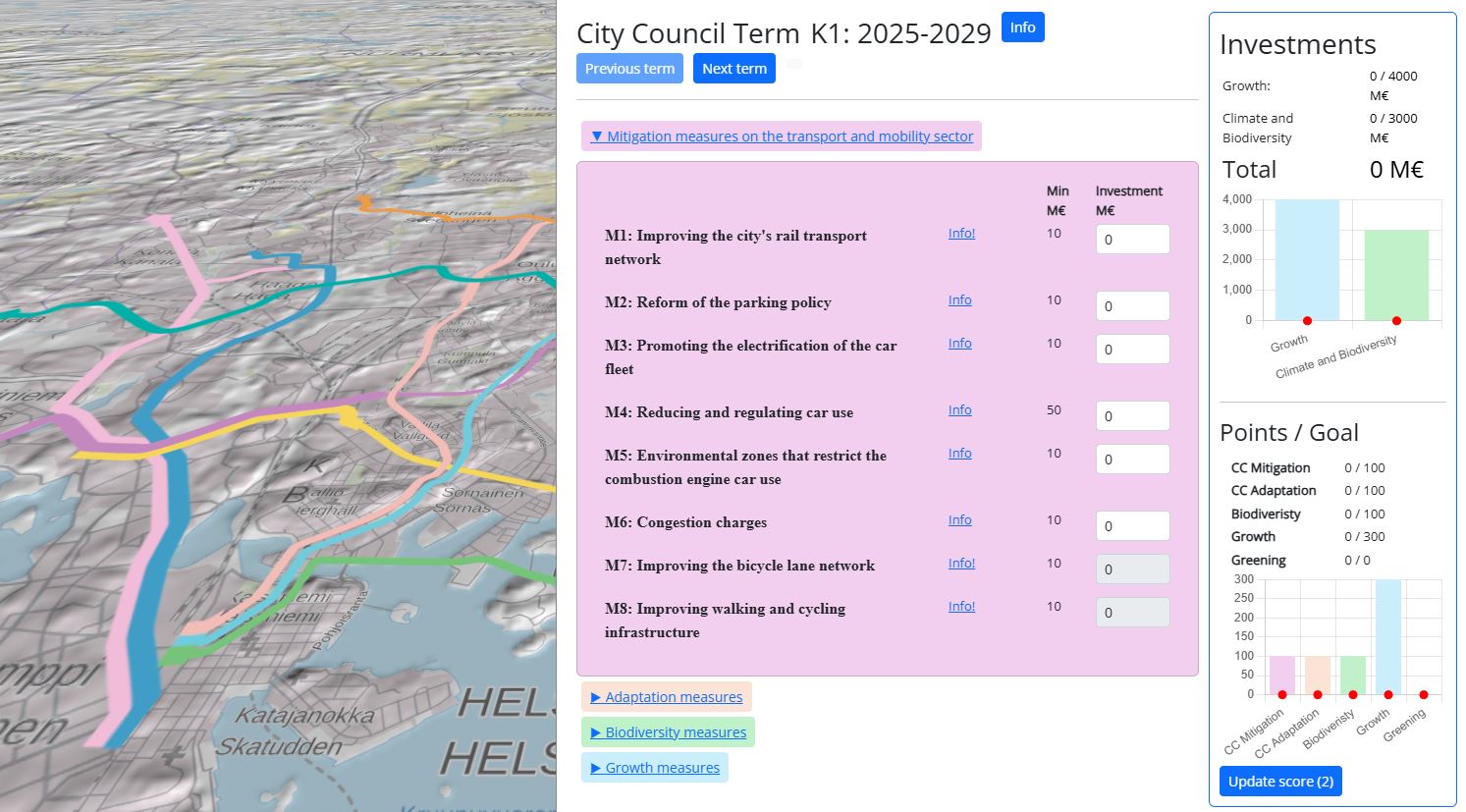
Screenshot from the serious game’s platform.
Each investment affects five key areas: climate change mitigation, climate change adaptation, biodiversity, greening (total amount of green areas and infra), and growth (provision of housing). Events occur in between the council terms that cause changes to the rules, while trade-offs become visible in subsequent terms after investment choices are made. The game is designed to be played by urban planning professionals, who play as themselves in small groups, with us facilitating and ensuring inclusive and well-justified decision-making. The goal is to reach sustainability and growth targets by 2040 within the given budget.
This spring, we tested the serious game with doctoral students in urban sustainability and gained valuable feedback on how to improve the game. For example, by adding a limited review option (an “update score” button) to the goals in each round, we removed a loophole that had allowed the students focus on “beating the numbers” by repeatedly reviewing the impacts of their investments without having to consider the synergies and trade-offs between the different measures. Following this, the game was introduced to urban planning and policy experts in Helsinki from the fields of land use and planning, traffic and mobility, housing and construction, and environmental and climate policy. The game was received well by these experts and our initial findings indicate that the serious game works both as an “active sensing” method of planners’ views regarding transformative urban climate governance and as a learning intervention that educates participants on the complexity of urban sustainability transformations in practice.
Both the historical board game and serious game invite players to envision an ideal city. They also embody the city of Helsinki during a time of transformation: while the board game captures a city that is moving towards its industrialisation, the serious game seeks solutions to the challenges of a post-industrial era and aims for identifying transition pathways for sustainable urban futures.
Karoliina Koskinen is a technical assistant at the Transformative Cities project’s WP5. She holds a Master of Arts in International Relations in Historical Perspective from Utrecht University, the Netherlands, and has worked in several multidisciplinary and international research projects. Her broader research interests include urban climate adaptation, climate justice and climate security. She aims to apply discourse analysis and historical-political perspectives to understand how current attitudes and climate policies have formed – and what needs to be addressed in the present to ensure just sustainability transformations. These themes are central in her application to the Doctoral Programme in Interdisciplinary Environmental Sciences at the University of Helsinki this autumn.